Choosing among steam turbine manufacturers in China is more useful when the comparison starts with your plant duty, steam conditions and long-term maintenance needs. An Indonesian power station buying a generating set, a factory requiring process steam and a petrochemical facility driving a compressor are evaluating different machines—even if all three enquiries use the words “steam turbine”.
This guide introduces ten Chinese manufacturers and explains what their product positioning means for procurement, spare parts and overhaul planning in Indonesia. The numbering is for navigation, not a market-share or quality ranking. A manufacturer’s wider portfolio does not mean that every configuration is available for every project.
Start with the application, not the manufacturer ranking
A condensing turbine, a backpressure turbine and an extraction turbine solve different plant problems. A condensing unit needs its exhaust system considered with the turbine; a backpressure unit must match the downstream steam demand; an extraction unit requires a clear operating envelope for both power and process steam. For industrial driving, the compressor or pump duty, speed range and train interfaces become part of the turbine specification.
Before sending the same enquiry to several manufacturers, define inlet steam conditions, normal and minimum steam flow, required exhaust and extraction conditions, electrical or shaft output, operating hours and the expected load profile. Include ambient and cooling conditions at the Indonesian site. Compare offers at the same operating points: nominal MW alone does not establish equivalent performance or project suitability.
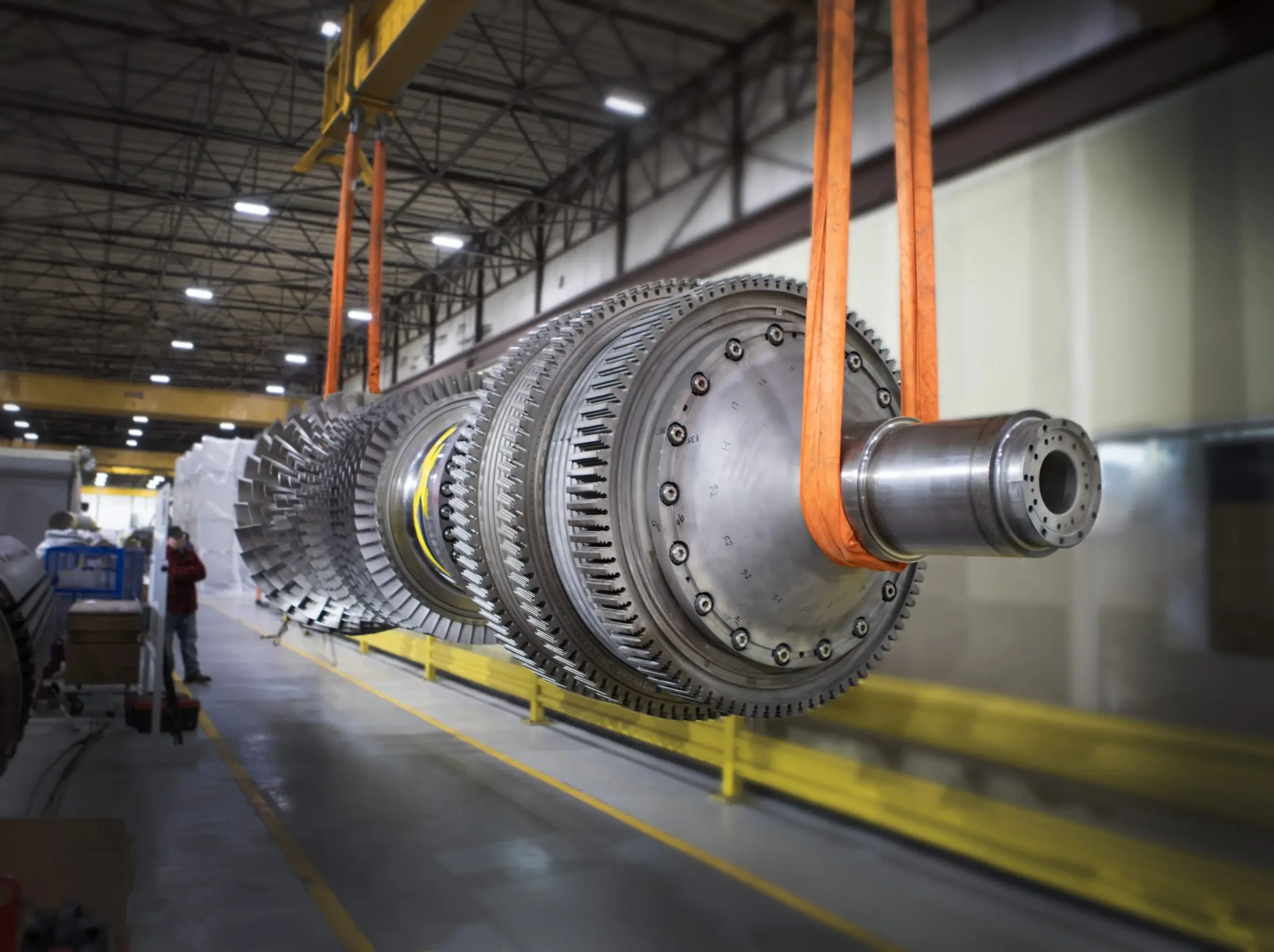
Illustrative turbine arrangement. This is not a drawing of any manufacturer’s specific model; actual designs and component locations vary.
Ten manufacturers and what Indonesian customers should examine
1. Harbin Turbine (哈汽)
Harbin Turbine belongs to the Harbin Electric group and manufactures power-generation turbines, including large thermal-power and nuclear-power equipment, as well as industrial turbines. It belongs on a shortlist when the project requires a power-station turbine rather than a small industrial driver. Its broad product range makes the exact unit identity more useful than the group name alone.
For an Indonesian owner, the practical issue is how the turbine, generator, condenser and plant systems are supported together. Before an overhaul, assemble the turbine serial number, drawing revisions, previous inspection results and modification history. A replacement blade, diaphragm or seal must match the installed design, not merely the rated MW. Design changes and equipment-specific acceptance criteria should remain connected to the responsible design authority.
Manufacturer or industry-source reference
2. Shanghai Turbine / Shanghai Electric (上汽)
Shanghai Turbine is part of the Shanghai Electric power-equipment business. Its background is closely associated with power-station steam turbines and the wider generating-equipment supply chain. For procurement, distinguish the turbine manufacturer from other Shanghai Electric entities supplying generators, auxiliaries or project services: a group-level name is not a complete equipment specification.
An Indonesian project should define the package boundary early: turbine only, turbine-generator set, or a broader plant package. For existing units, examine the actual model, installation year and retrofit records before discussing spare parts or restoration. A quotation should identify responsibility for valve work, bearings, alignment, generator interfaces and startup verification. This prevents important interface work from falling between separate contracts.
Manufacturer or industry-source reference
3. Dongfang Turbine (东方汽轮机)
Dongfang Turbine, part of Dongfang Electric, covers large power-generation equipment and industrial turbine applications. Its industrial portfolio includes generating and driving duties. This distinction matters: two Dongfang turbines can serve very different processes and require different support arrangements even when their nominal outputs appear similar.
When comparing a new machine, request performance at the actual steam conditions, exhaust or extraction pressure and expected operating points. For an installed unit, separate routine overhaul from a proposed change in steam admission, extraction duty or flow path. A retrofit requires an engineering scope and agreed verification conditions; it should not be treated as simply replacing worn components during a shutdown.
Manufacturer or industry-source reference
4. Hangzhou Turbine / Hangqi (杭汽轮)
Hangzhou Turbine has a strong focus on industrial steam turbines, particularly machinery-driving applications. Its products serve industries such as petrochemicals, steel and energy. For an Indonesian plant operating a turbine-driven compressor, pump or other process machine, the driven equipment and process duty are central to the selection—not secondary details added after the turbine is chosen.
Evaluate the operating-speed range, driven-machine characteristics, coupling, lubrication and governing interfaces as a connected system. A generator-turbine overhaul checklist cannot automatically be transferred to a compressor train. For existing equipment, provide both turbine and driven-machine records, including relevant vibration and alignment history. State whether the outage contract covers the whole train or only the steam turbine.
Manufacturer or industry-source reference
5. Nanjing Turbine and Electric Machinery / NTC (南汽)
Nanjing Turbine and Electric Machinery manufactures steam turbines and generators alongside other rotating equipment. Its steam-turbine portfolio includes conventional power-station and waste-to-energy applications. The combination of turbine and electrical-machine capabilities makes it useful to evaluate the generating set as a package rather than comparing only the turbine purchase price.
For Indonesian buyers, check which company supplies the generator, excitation, control system and auxiliaries, and who owns the interface documentation. Waste-to-energy or other industrial projects should be assessed using the expected steam envelope and operating pattern. During a major overhaul, coordinate mechanical findings with the generator inspection plan so the steam turbine is not ready while an unresolved electrical issue prevents restart.
Manufacturer or industry-source reference
6. Qingdao Jieneng (青岛捷能)
Qingdao Jieneng has a long manufacturing background in steam turbines and associated generating equipment. Its relevance extends to industrial power and heat-utilization projects. Buyers assessing Jieneng should look beyond the brand name and examine how the proposed turbine configuration matches the balance between electricity generation and process-steam demand.
A condensing, extraction-condensing or backpressure machine represents a different plant operating arrangement. Compare annual steam-demand patterns, operating flexibility and condenser requirements before choosing the configuration. For a retrofit, such as changing the operating duty, require a documented heat balance, component scope, control implications and acceptance plan. A mechanically feasible change is not automatically the most suitable commercial solution for the plant.
Manufacturer or industry-source reference
7. Qingneng / QNP (青能)
Qingneng is associated with steam turbines and turbine-generator equipment for power-generation and industrial-driving duties. For buyers, the QNP brand should be linked to the exact manufacturer named on the quotation, nameplate and technical documents. Qingneng is separate from Qingdao Jieneng and Hangzhou Chinen; similar transliterations must not be used interchangeably in purchasing records.
Its relevance for Indonesian customers includes evaluating a new turbine-generator package and support for existing equipment. Ask for a clear list of included controls, electrical panels, auxiliaries and installation services. Where an energy-saving upgrade is proposed, establish the baseline operating conditions and measurement method first. Compare output and steam consumption at equivalent conditions rather than accepting a percentage improvement without a defined basis.
Manufacturer or industry-source reference
8. Beijing Beizhong (北京北重)
Beijing Beizhong manufactures steam turbines, generators and power-station auxiliaries. Its published turbine portfolio includes reaction, condensing and extraction arrangements. This makes configuration and technical lineage important when identifying an existing unit: the same manufacturer name does not mean every model shares interchangeable internals or the same inspection requirements.
For Indonesian owners, retain the complete turbine-generator documentation set and record previous component replacements. Before a major overhaul or modernization, identify the installed bearing, seal, valve and governing designs. A proposed replacement or upgraded component should carry a drawing reference and a clearly defined verification scope. Mechanical, auxiliary-system and electrical interfaces should be allocated to named parties in the contract.
Manufacturer or industry-source reference
9. Hangzhou Chinen Turbine (杭州中能透平)
Hangzhou Chinen focuses on industrial turbines and equipment used in industrial driving and energy recovery. Its published applications include steel and metallurgy, petrochemicals and waste-heat utilization. Chinen and Hangzhou Turbine are separate manufacturers; both being based in Hangzhou does not establish common model numbers, drawings or spare-parts compatibility.
For an Indonesian industrial project, begin with the available steam source and process requirements. Waste-heat recovery equipment may operate across a changing steam envelope, so selection should reflect actual operating hours and conditions. For a driving turbine, include the driven-machine data. For maintenance, obtain the installed configuration and revision history before requesting bearings, seals, blades or valve parts.
Manufacturer or industry-source reference
10. Luoyang Zhongzhong / CITIC Heavy Industries (洛阳中重)
Luoyang Zhongzhong power-generation equipment is associated with the CITIC Heavy Industries equipment portfolio, which includes turbine-generator products. For an existing unit, legacy names on nameplates or manuals are valuable identification clues. The name on a current commercial proposal should still be reconciled with the original machine records and the party supplying technical support.
For Indonesian customers planning an overhaul, an older unit should be assessed from its present condition and documented configuration. Build a register of original parts, replacements and modifications; old drawings may not represent everything currently installed. Procurement should distinguish direct replacement, repair of an existing component and redesign. These options involve different evidence, approval responsibilities and schedule assumptions.
Manufacturer or industry-source reference
How to compare quotations on a common basis
The lowest turbine price may exclude equipment or services that another proposal includes. Ask each supplier to return a compliance matrix against one common specification. Record deviations and optional items explicitly rather than discovering them during installation.
Performance: guaranteed output and steam consumption at agreed conditions, part-load points, measurement boundaries and correction method.
Package boundary: generator or driven machine, governing and protection, lubrication, condenser where applicable, electrical panels, instruments, installation and commissioning.
Documentation: general arrangement, foundation loads, piping interfaces, control interfaces, operation and maintenance manuals, parts lists and agreed drawing revisions.
Serviceability: inspection access, lifting arrangements, special tools, replacement-component identification and the division between site and workshop work.
Commercial responsibility: delivery assumptions, shipping scope, site unloading, import responsibilities, warranty terms, acceptance milestones and a named route for resolving technical questions.
For Indonesian projects, clarify the language of manuals and inspection records, the working language of the field team and how local personnel will be trained. Confirm the applicable project and local requirements in the specification. Do not assume a general catalogue statement proves compliance with a particular procurement standard.
After-sales support: distinguish coverage from project responsibility
After-sales support can mean parts supply, technical consultation, a field inspection, a major overhaul or an engineered retrofit. A useful contract states which of these are included, who approves repairs, who supplies design information and who signs the final acceptance records.
TURBINE OVERHAUL INDONESIA provides comprehensive sales, after-sales and retrofit support for Qingneng, Qingdao Jieneng and Beijing Beizhong, with branch-level service coverage. For Dongfang, Hangzhou Turbine and Nanjing Turbine, support is provided at first-tier distributor level for major overhaul and spare parts. Major-overhaul services are also available for Harbin, Shanghai, Hangzhou Chinen and Luoyang Zhongzhong equipment.
For any manufacturer, define the scope against the specific installed machine. During warranty work, changes to design or operating duty, and decisions requiring original design information, establish the manufacturer interface before work starts. Local overhaul execution and manufacturer technical input can form complementary parts of the same outage plan. See the steam turbine overhaul scope and generator overhaul interface.
Ordering spare parts: a brand and MW rating are not enough
Two machines from the same manufacturer may have different bearing dimensions, seal arrangements, blade geometry or valve components. Previous retrofits can further change the installed configuration. A photograph helps identify a component, but it cannot establish material, fit or compatibility by itself.
A useful enquiry for steam turbine spare parts includes the manufacturer, full model, serial number, component name, drawing and part numbers, revision, quantity and required delivery window. Add photographs and relevant measured dimensions where drawings are missing. State whether the enquiry is for the turbine, generator or auxiliary system.
Separate scheduled replacements from contingency stock. Bearing repair versus replacement, gland-seal replacement and rotor or blade work should follow equipment-specific assessment. Require traceable identification, agreed material and inspection documentation, and written confirmation of the proposed part’s applicability. Do not infer compatibility solely from a similar machine model.
Major overhaul or retrofit: make the decision before fixing the outage promise
A major overhaul normally investigates and restores equipment condition within an agreed operating duty. A retrofit changes part of the design or duty—for example, the flow path, steam utilization arrangement or governing configuration. Combining the two may be appropriate, but the engineering, procurement and acceptance requirements must be planned together.
Provide operating history, symptoms, vibration trends, previous inspection reports, clearance records and modification drawings. Use inspection and diagnostics to define the work where the cause of an issue remains uncertain. A vibration complaint is not, by itself, evidence that rotor balancing is the correct repair.
Divide the proposal into base inspection work, condition-dependent repairs, planned parts and optional upgrades. Agree decision gates for scope changes and record their cost and schedule impact. Include generator and auxiliary-system interfaces, logistics and workshop turnaround assumptions. The outage planning guide explains how to organize these decisions before the turbine is opened.
Questions Indonesian owners should ask before awarding the work
Does the proposal match our actual steam and process conditions, including part-load operation?
Who is accountable for each mechanical, electrical and control interface?
Which documents and special tools must be available before mobilization?
How will additional damage found during inspection be assessed and approved?
Which parts are identified and ready, and which require technical confirmation?
What inspection, repair, alignment and testing records will be handed over?
What are the equipment-specific return-to-service criteria and unresolved-work process?
Choose the right machine—and a support plan that can be executed
A useful manufacturer comparison connects product type to actual plant requirements. For existing equipment, the strongest starting point is an accurate machine identity, usable technical records and a clear outage scope. These help owners compare suppliers fairly and reduce avoidable uncertainty in procurement and maintenance.
To discuss a Chinese-manufactured turbine operating in Indonesia, send the nameplate, model, capacity, operating duty and project requirements. A specific enquiry supports a specific technical response—whether the requirement is a new package, spare parts, a major overhaul or a retrofit.