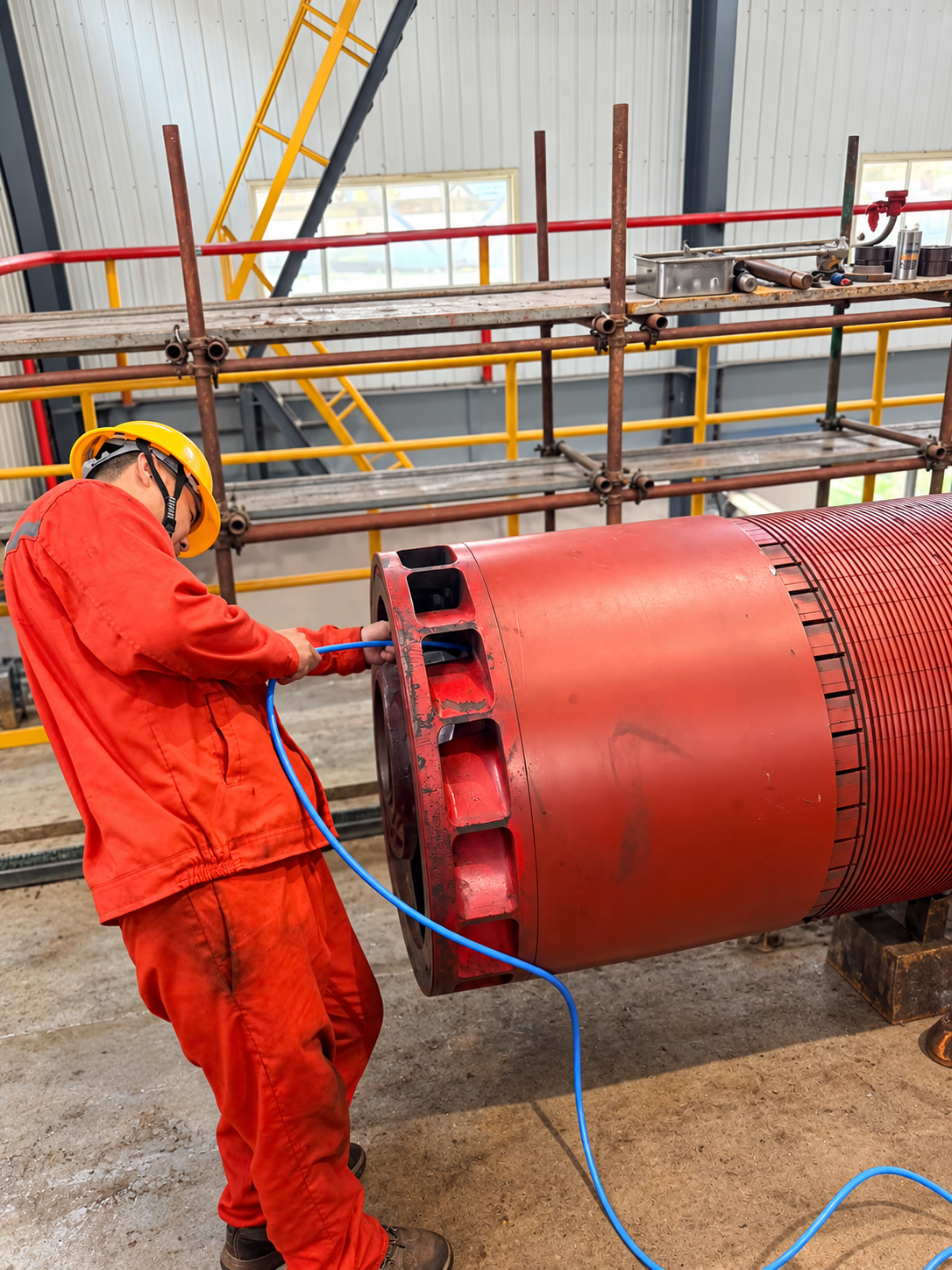
Sparking at a generator’s slip rings is a visible symptom, not a diagnosis. It may be associated with brush contact, the collector-ring surface, excitation conditions, or other machine conditions. Replacing brushes without identifying the reason can leave the cause in place and allow damage to continue.
This guide is for plant teams planning a generator inspection or overhaul. It explains what to record, what the inspection should distinguish, and what information makes a repair enquiry useful. The generator manufacturer’s instructions and the plant’s approved safety procedures remain controlling for the specific unit.
First confirm which brush system is involved
Some synchronous generators use stationary carbon brushes to transfer excitation current to rotating field collector rings. A separate shaft-grounding brush or braid may provide a path for residual shaft current. Measuring brushes used by a monitoring or protection circuit may have another purpose. These systems can look similar from outside but are not interchangeable in function or specification.
The GE Vernova collector and grounding brush overview distinguishes excitation collector brushes from shaft-grounding arrangements and warns that poor brush-system maintenance can damage ring surfaces and insulation. Confirm the generator excitation design and brush function from the unit documents before interpreting a finding.
Why sparking deserves a prompt, evidence-led review
Brushes are intended to maintain electrical contact with a rotating surface. If contact becomes unstable, arcing can mark or pit the ring and damage nearby insulation. Severe deterioration can raise the risk of a flashover. The precise risk and response depend on the generator design and observed condition, so plant personnel should use the unit’s operating and safety procedures and escalate abnormal or worsening sparking through the site’s established process.
Do not treat a visual observation as permission to touch, adjust, or remove brush gear on an energized machine. Any operating inspection or intervention must follow the equipment-specific manual and the plant’s authorized work controls.
Common areas to investigate
The cause should be established from the complete brush-and-ring system rather than assumed from the appearance of one brush. Depending on the design, inspection may consider:
Brush grade and dimensions against the specified type for the generator and operating duty.
Whether each brush moves freely in its holder, and whether the holder, spring, lead, and terminal connection are in sound condition.
Uneven brush wear, damaged pigtails, contamination, abnormal dust, or evidence of poor contact.
Collector-ring surface condition, including grooves, scoring, heat marks, pitting, or uneven wear.
Ring runout, alignment, vibration, bearing condition, and relevant excitation or load history where applicable.
Ventilation and dust-control provisions in the brush enclosure, as specified by the manufacturer.
An ABB generator manual’s slip-ring section lists examples such as brushes sticking or fitting too loosely, loose connections, unsuitable or unequal brush pressure, an unsuitable brush type, and a deteriorated sliding surface. It is an equipment-specific manual for its covered machine family, not a universal turbogenerator acceptance standard. Use such examples to frame questions, then apply the actual generator documentation and measured findings.
What an outage inspection should establish
A useful inspection records both the brush gear and the collector-ring condition. Depending on the generator design and the work scope, the inspection may document brush identification and wear distribution; holder and spring condition; connection integrity; surface condition across each ring; and relevant insulation, alignment, runout, or ventilation findings. Record measurements against the OEM limits for the exact generator. There is no single brush length, spring pressure, ring diameter, or surface-finish limit that safely applies to every machine.
The findings should support a clear decision: continue with condition monitoring, restore the brush system, repair the ring surface, or plan a more extensive generator rotor inspection. Cleaning, brush bedding, ring machining, or replacement are not interchangeable routine steps; each needs to be selected for the ring material, damage, design limits, and approved procedure. The GE Vernova generator inspection and test service overview illustrates that generator work can span collector-ring replacement and broader rotor or winding inspection. It is an example of industry scope, not a claim of authorization or identical capability by another provider.
Separate brush sparking from other generator findings
Sparking at an excitation collector ring does not, by itself, prove a rotor earth fault, winding defect, or turbine vibration problem. Conversely, a rotor-grounding alarm or abnormal vibration should not be dismissed as a brush issue without checking the relevant protection, measurement, and mechanical evidence. Keep each observation tied to its own circuit and measurement source; the generator’s protection diagrams and test procedures matter.
If more than one symptom is present, correlate timestamps, load, excitation state, alarm records, maintenance history, and inspection findings. The purpose is to identify whether symptoms share a cause or merely occurred together—not to infer a root cause from timing alone.
Information to prepare for a repair enquiry
For a focused technical review, provide as many of these as are available:
Generator manufacturer, model, serial number, rating, and excitation arrangement.
A clear description of which collector, grounding, or measuring brush system is involved.
When the sparking occurs, how it changes with load or operating condition, and whether it is new or recurring.
Relevant alarms, event records, operator observations, and recent maintenance history.
Brush grade or part identification, dimensions, wear pattern, holder condition, and photographs taken under approved safe conditions.
Ring surface observations and any measurements already recorded against the unit manual.
Applicable drawings, maintenance instructions, previous inspection reports, and the planned outage window.
This helps distinguish a brush-system issue from ring damage or a wider generator inspection requirement. Do not substitute a photograph for the generator identity or the OEM’s measurements.
How this fits into generator overhaul
Collector and grounding brush findings can be reviewed as part of a broader generator overhaul, inspection, or repair scope. The actual work is defined after equipment identity, records, and inspection evidence are reviewed. For related services, see generator overhaul, inspection and diagnostics, and repair and restoration. Replacement brush or collector components, if required, should be identified from the machine documentation and confirmed dimensions through the spare-parts enquiry page.
Questions plant teams often ask
Does sparking always mean the carbon brushes are the wrong type?
No. Brush specification is one item to verify, but contact freedom, connections, pressure, surface condition, operating conditions, and other machine-specific factors may also matter.
Can all generator slip rings be repaired by polishing or machining?
No universal method applies. The permitted repair depends on ring material, damage, dimensions, manufacturer limits, and approved procedure. Assess the specific ring before choosing a repair.
Are excitation brushes and shaft-grounding brushes the same?
No. They can have different electrical functions and specifications. Identify the circuit from drawings and equipment records before ordering parts or defining work.
Can one sparking event confirm the root cause?
No. A single observation is a reason to preserve evidence and investigate; it is not enough to establish a root cause or predict the required repair.